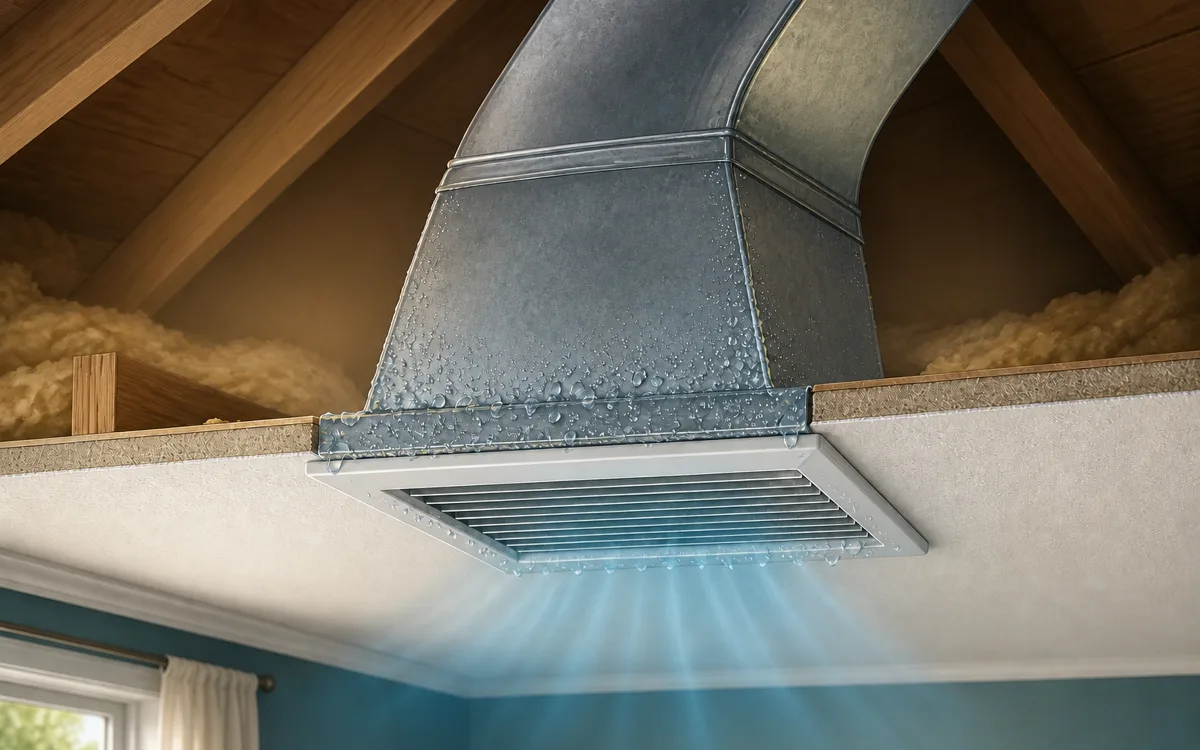
Water beading on the grille or at the ceiling edge only while cooling often means the metal register or duct boot is colder than the surrounding air's dew point. Water flowing from inside the duct, spreading across the ceiling, appearing when cooling is off, or tracking with rain can point to a condensate drain, roof, or plumbing leak instead. Find where the water starts before sealing, drying, or adjusting the HVAC system.
What matters most
- Wipe the area dry and identify whether water begins on the grille face, at the boot perimeter, inside the duct, or away from the register.
- Compare room temperature and RH with the vent surface temperature; a surface at or below dew point supports condensation but does not identify the defect by itself.
- One wet vent versus several—and cooling-only moisture versus rain- or shutdown-linked moisture—changes the next inspection.
Match the first wet point and timing to the likely water path
Do not diagnose from the largest stain. Wipe the grille and nearby ceiling dry, then note the first place that becomes wet and whether the air conditioner, rain, or both were present.
| What becomes wet first | What the pattern suggests | Next check |
|---|---|---|
| Droplets form on the grille face or metal edge only while cooling | The metal surface may be at or below the room dew point. | Log room temperature/RH and the grille temperature; compare a second supply register and reduce the room moisture load before changing equipment. |
| One boot-to-ceiling seam beads while other vents stay dry | A local air-sealing or insulation gap may expose the cold boot to humid attic or cavity air. | Have the boot, insulation, and air seal inspected from a safe access point; do not disturb wiring, insulation, or attic walkways casually. |
| Water comes through the louvers or appears below an attic air handler | Cooling condensate may be overflowing from a pan or blocked, damaged, or poorly routed drain. | Stop treating it as a surface-humidity problem and arrange an HVAC drain and pan inspection. |
| A wet patch starts away from the vent or grows when cooling is off | Roof, plumbing, or another bulk-water path is more plausible than register condensation. | Compare the timing with rain and plumbing use, then route the inspection to the matching trade. |
| Drywall is soft, sagging, yellowed, or dripping near a light or wiring | Material damage or an electrical hazard may already be present. | Keep people away, avoid touching the fixture or wet material, and use qualified HVAC, building, and electrical help promptly. |
Find the first wet point, not the biggest stain
Dry the grille and a hand-width of ceiling around it. During the next cooling cycle, check at 5, 15, and 30 minutes without removing the register. Photograph the first bead or darkened area and note whether it begins on metal, at the metal-to-drywall seam, inside a louver, or on the ceiling away from the vent.
Compare another supply vent served by the same system. Several vents sweating at once makes a high indoor dew point or system-wide cold-surface problem more plausible. One isolated vent makes a local boot, insulation, air-sealing, drain, roof, or plumbing path more important.
Calculate a dew-point margin
Place a hygrometer in the occupied room away from the supply jet and wet ceiling. Record room temperature and RH, then take a cautious surface-temperature reading on the grille. An infrared thermometer can read shiny metal inaccurately, so treat one reading as a comparison and follow the device instructions.
At 75°F and 60% RH, the estimated dew point is about 60.2°F. A grille near 56°F is roughly 4°F below that threshold, so surface condensation is plausible. At the same 75°F but 50% RH, the dew point falls to about 55.1°F; the same grille now has about a 1°F margin. Use the calculator with your own readings rather than copying this example as a universal limit.
- Room air: temperature and RH away from the supply jet
- Cold surface: grille or boot-edge temperature
- Margin: surface temperature minus calculated dew point
Use timing to separate condensation from a leak
Surface condensation should track a cold surface: it develops while cool air is flowing and eases after the metal warms. A drain or pan problem can deliver water from inside the HVAC path, and a roof or plumbing leak may continue when the cooling system is off.
Run only an observation test—do not force longer equipment runtime to create a leak. Record the cooling start and stop times, rainfall, plumbing use above the area, and when each new drop appears. If the ceiling is soft or actively filling with water, stop the test and escalate rather than waiting for a cleaner pattern.
Choose the repair for the confirmed mechanism
For a room-wide high dew point, control moisture sources first: close humid outdoor-air paths, exhaust showers and cooking outdoors, verify dryer venting, and confirm the cooling system is operating and draining as intended. Lowering RH can create a safer margin, but it should not hide active water entry.
For a local boot problem, DOE guidance emphasizes sealing register boots to the penetrated ceiling, wall, or floor and maintaining complete duct insulation. For water coming from inside the duct or an attic unit, have the drain, pan, and connected cooling equipment inspected before sealing the ceiling edge. Do not change blower speed, close multiple registers, open refrigerant components, or enter an unsafe attic as a diagnostic shortcut.
Keep a one-cycle evidence log
A compact log is usually more useful than a week of vague observations. Write down room temperature/RH, grille temperature, system state, first wet location, and weather at cooling start, 15 minutes, 30 minutes, and 15 minutes after shutdown.
Share the sequence and photos with the HVAC technician, roofer, plumber, or building professional. It helps the right person start at the likely water path without presenting the log as a professional airflow, duct-leakage, or materials assessment.
A measured action plan
- 1Protect the floor only if it is safe; keep away from wet lighting, soft drywall, and sagging ceiling material.
- 2Wipe the area dry, compare a second vent, and record the first wet point at 5, 15, and 30 minutes of normal cooling.
- 3Measure room temperature/RH and the grille surface, then calculate the dew-point margin.
- 4Repeat the observation after shutdown and note rain or plumbing use so the timing can separate cooling condensation from bulk water.
- 5Send the evidence to the trade that matches the path; do not seal the ceiling edge until drain, pan, roof, and plumbing sources are ruled out.
Useful tools to compare
These product categories match the checks in this guide. Compare specifications and current instructions; they are not hands-on test recommendations.
As an Amazon Associate I earn from qualifying purchases. Your price does not increase.Sources & further reading
- Building America Solution Center — Sealing HVAC Supply and Return Register Boots ↗
- U.S. DOE Building Science Education — HVAC Sealed and Insulated Metal Ducts ↗
- Building America Solution Center — Corrosion-Resistant HVAC Condensate Drain Pans ↗
Reviewed against the linked sources in August 2026. Product instructions and local codes take priority for a specific installation.